Future Fit
HR Culture

Transforming the culture in your HR team is the cornerstone to becoming Future Fit

The Challenges

It is now common cause that organisations are succeeding based on a particular type of culture. Examples such as Apple with its design-obsessed culture and Netflix with their “No Rules” culture have shown the levels of success that can be achieved with a diligent focus and continuous management of organisational culture.


Unfortunately, most organisations and particularly HR teams are stuck in post-industrial, hierarchical cultures that constrain growth and success. Their approach of a values refresh, long lists of value aligned behaviours, and 360-degree peer evaluations, are outdated and ineffective in shifting organisational culture.

The Solution

Culture as the driver of all behaviours in your team, is the most powerful determinant of success. It requires a systemic approach to transform and modernize it. We offer HR teams the solutions to analyse and understand their current culture and to plot a path to transform the current culture over the long term.


As part of the culture analysis and mapping process we introduce you to the Switch change methodology of Heath & Heath which equips your HR team to deal with continuous evolution of the organisational culture.

Another key component to cultural transformation is the capability of leaders to appreciate and understand their role in culture formation. We assist by equipping HR leaders in the organisation with an understanding of the ambit, mechanics and evaluation of culture.

The Cultural Context

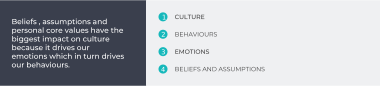
Culture is the expression of the common behaviours of a group. As such, culture is influenced by a number of components, all of which needs to be examined and changed in order to achieve a permanent cultural change.
The components that share culture are illustrated here:

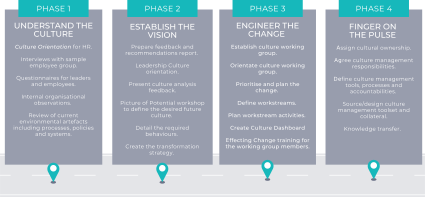
GrayFeather Culture Transformation Approach

Our comprehensive 4 phase cultural transformation approach for organisations commences with a deep dive into the current culture and then the heavy lifting to engineer and steer the change you want to see.

During the process, we focus on transferring understanding and skills to your leaders and HR team so that they can actively maintain the cultural transformation.
Modern Successful Cultures

There are common cultural characteristics that successful organisations share. The twelve predominant characteristics are listed here.

At Grayfeather, we offer you advice, insight, tools and methods to evolve any of these characteristics within your organisation.
The core assumption is that everyone is striving to give their best and do their best and are therefore trusted to make decisions about how and where to work.
Team members are clear on their responsibilities and expected deliverables, and they are accountable for them. Members keep each other accountable.
Team members act like mini-CEO’s for their area of responsibility, they make decisions, plan and execute in the best way they decide on.
Decisions about money, strategy, staff and operations are openly discussed and shared. Employees have access to company goals. Targets and financial information.
Team members are enabled through comprehensive structures, processes guidelines, methodologies, frameworks and systems.
There is a deep sense of caring for each employee, for clients and other stakeholders that comes form empathy and a human centric philosophy.
Everyone is in the habit of proposing new ideas, innovation is valued and rewarded and there is evidence of innovation in all aspects of the organisation.
Leaders change decisions when required, produce new ideas when new situations present and are able to pivot and change course rapidly. Team members are change resilient and can adopt quickly.
There is a laser like focus on what is important and what must be achieved. Goals are used to drive performance, and everyone gets regular feedback on progress.
There is a deep conviction about and understanding of the purpose that the organisation wants to achieve, and it is shared by team members.
Team members are constantly encouraged and enabled to learn, enquire and gain competence. Managers user all meetings as teaching opportunities and team member coaching happens constantly.
Thinking about the customer permeates every meeting, discussion, project and activity in the organisation. All team members are competent in design thinking, empathy and customer service.

Enquire now

Find out more, drop us a line.