
Future Fit Talent Agile Organisations
We offer a solution focused on creating the conditions for successful Agile implementation and the enablement of your people through every step of the process.
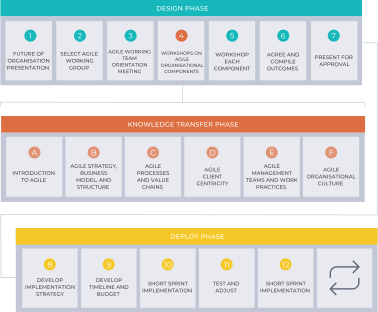
Our deployment approach consists of a design phase, a knowledge transfer phase, and then repeated implementation sprints.
The Challenges
The evidence linking organisational agility to success in the modern marketplace is pervasive. The challenge is not to convince leaders of the need to become more agile, but for leaders to find the best way to execute the transformation.
The Solution
Agile transformation is a systemic change for an organisation that requires change in mindset, culture, leadership, structure and work practices.
Grayfeather takes a comprehensive approach to Agile transformation through a systematic approach.We start with forming an Agile Working Group and with the members of this working group attending 5 courses to familiarize them with the scope and ambit of Agile.
This equips them to be able to make the right Agile decisions for their organisation.
With the training completed, the working group convenes for a series of workshops to discuss and debate the decisions that will shape the changes for the organisation that will result in Agile.Grayfeather Agile Transformation Solution
The evidence linking organisational agility to success in the modern marketplace is pervasive. The challenge is not to convince leaders of the need to become more agile, but for leaders to find the best way to execute the transformation.
Our Agile Knowledge Transfer Curriculum
For an organisation to become agile, members have to master important knowledge sets and develop new skillsets. We offer a 5-module curriculum to start the process of knowledge acquisition. Each module addresses practical aspects of agile transformation and provides the working group with an opportunity to think through key issues.
Module 1
AGILE ORIENTATION
- What is Agile. Agile defined.
- The origin of Agile in the Lean movement of the 80s
- The evolution of organisations in the early 21st century
- The difference between Agile project management and agile organisations
- The characteristics of agile organisations
- The process of agile transformation
Module 2
AGILE STRATEGY; BUSINESS MODELS AND ORGANISATIONS
- The impact of agile on strategy
- The agile strategy process
- Rethinking business models
- The characteristics of agile business models
- The hierarchy versus agile organisation
- The characteristics of the agile organisation
- Organisation structures in agile organisations
Module 3
AGILE VALUE CHAINS AND PROCESSES
- Thinking about value chains
- Agile’s impact on value chains
- Designing for agile value chains
- Process design in agile organisations
- Example of agile processes
- Managing processes in agile organisations
Module 4
CUSTOMER CENTRICITY IN AN AGE OF AGILITY
- The impact of agile on markets
- Agile reframes the customer
- Design Thinking
- The impact of agile on products
- Building the right product
- Building the product at the right
- Building the product at the right speed
Module 5
AGILE MANAGEMENT, TEAMS AND WORK PRACTICES
- Leadership and management in agile organisations
- Agile management practices
- Agile teams and team structures
- Management in agile teams
- Work practices that agile teams use.
- Squads, practices and tribes – how they interrelate.
Module 6
AGILE CULTURE
- Agile culture is the key to success
- Defining an agile culture
- Characteristics of agile cultures
- Designing the agile culture for your organisation
- Establishing and evolving agile cultures
- Continuous management of the culture
Tools For Agile Challenges

DECISION MATRIXES:
Devolved decision making is a key tenet of an Agile organisation. This has an impact on governance frameworks. We assist organisations to review decision making matrixes and on adapting their governance and controls.

JOB DESCRIPTIONS AND TEAM RESPONSIBILITIES:
With an Agile implementation, employees experience a change in their job descriptions. They might be a squad, chapter or tribe leader and they need clarity on how to prioritise their efforts, to understand what is expected from them and to know how to engage with other team members. We help to orientate employees with regards to their new responsibilities and to establish the team dynamics post-transformation.
AGILE WORK PRACTICES:
- Daily-stand-ups
- PI Planning
- Sprints
- OKRs
- User Stories
- Planning Poker
- Ceremonies

TOOLS AND TECHNOLOGIES:
There is a range of technologies and tools that organisations can use to promote organisational agility, such as Kanban boards and their technical version in Trello. We assist our clients to source, select, and implement tools to support Agile work practices.

EMPLOYEE DEVELOPMENT
The Agile organisations require competent, self-directed employees that will take initiative and own their accountability. This mindset is imperative for an Agile organisation. GrayFeather has developed a 5-course curriculum to provide employees with the necessary emotional skills and mental abilities to equip them for the Agile working environment.